Category: Uncategorized

  • Debunking Viral Copypasta: The Mystery Pocket Object Meme

    Debunking Viral Copypasta: The Mystery Pocket Object Meme

    The dramatic caption accompanying this post (“I found this in my husband’s pants pocket… I’ve been holding it in my hand for half an hour…“) is a classic social media copypasta template. Content creators regularly take alarming, high-contrast medical images and pair them with completely nonsensical text about finding objects in laundry, cars, or drawers to trigger confusion, drive comments, and boost algorithm engagement.

    What the Image Actually Shows

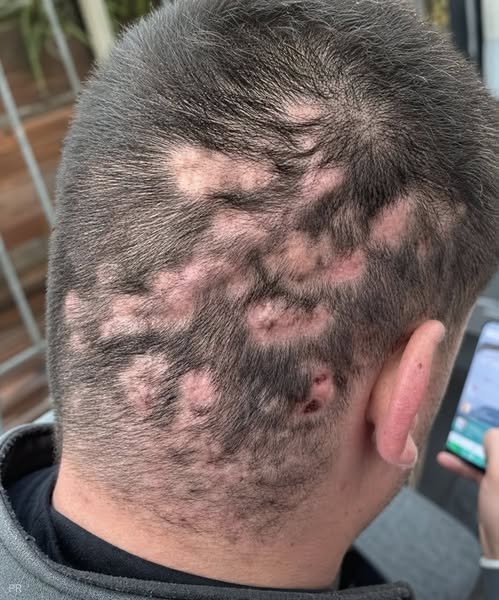
    • Medical Reality: The photograph displays patchy hair loss on the back of a scalp, indicative of an inflammatory scalp condition or severe autoimmune hair loss such as Alopecia Areata or dissecting cellulitis of the scalp.
    • Not an Object: The image depicts human skin and hair follicles, not a physical item, coin, tool, or substance that could ever be carried in a pocket.
  • Debunking Viral Myths: Alopecia Areata vs. Sensational Headlines

    Debunking Viral Myths: Alopecia Areata vs. Sensational Headlines

    Incomplete titles like “These are the earliest signs of sleeping with…” are common social media engagement bait designed to spark fear by linking medical conditions to shock-inducing causes. The patch-like hair loss visible on the back of the scalp in the image is a classic presentation of Alopecia Areata—an autoimmune condition—or similar scalp inflammatory disorders, not the result of unusual sleep habits, wet hair, or viral hygiene myths.

    What Causes Alopecia Areata?

    • Autoimmune Mechanism: Alopecia Areata occurs when the body’s immune system mistakenly targets healthy hair follicles, causing them to enter a resting phase where hair falls out in distinct, smooth, coin-shaped or patchy areas.
    • Triggers and Factors: While the exact cause remains under research, episodes are often linked to genetic factors, immune system dynamics, or periods of severe physiological or psychological stress.
    • Non-Contagious Nature: Alopecia Areata is completely non-contagious and has no connection to sleeping habits, physical contact, or bed hygiene.

    Medical Evaluation and Treatment Options

    Viral headlines claiming simple daily habits cause patchy hair loss distract from proper medical care. Dermatologists evaluate scalp patchy hair loss using physical examinations or dermoscopy to distinguish Alopecia Areata from other conditions like fungal infections or scarring alopecias. Treatments often include topical or injectable corticosteroids, immunotherapy, or target-specific medications to suppress the localized autoimmune response and encourage hair regrowth.

  • Honoring the Legacy of Michael Byrne (1943–2026)

    Honoring the Legacy of Michael Byrne (1943–2026)

    The breaking news card refers to the passing of veteran British character actor Michael Byrne, who died at age 82. With a screen career spanning over five decades and more than 170 credits across film, television, and theatre, Byrne was one of the most recognizable and versatile working actors in British cinema.

    Notable Roles and Filmography

    • Indiana Jones and the Last Crusade (1989): Portrayed the ruthless SS officer Colonel Ernst Vogel.
    • Harry Potter and the Deathly Hallows – Part 1 (2010): Played the elderly version of the dark wizard Gellert Grindelwald.
    • Braveheart (1995): Appeared as Smythe, the brutal English soldier.
    • Tomorrow Never Dies (1997): Played the Royal Navy Admiral in command of HMS Bedford.
    • Coronation Street (2008–2010): Featured in 67 episodes as Ted Page, Gail Platt’s long-lost father.
  • This image references the passing of Michael Byrne, the veteran British actor who passed away at the age of 82 on June 20, 2026.

    This image references the passing of Michael Byrne, the veteran British actor who passed away at the age of 82 on June 20, 2026.

    Across a career spanning over five decades, Byrne built a reputation for bringing unforgettable depth and intensity to complex roles and iconic cinematic villains.

    Key Career Highlights

    • Indiana Jones and the Last Crusade (1989): Portrayed the ruthless Nazi Colonel Ernst Vogel.
    • Harry Potter and the Deathly Hallows – Part 1 (2010): Played the elderly dark wizard Gellert Grindelwald.
    • Braveheart (1995) & Other Films: Featured in notable supporting roles across major historical and action titles, including Braveheart, Apt Pupil, Tomorrow Never Dies, and Gangs of New York.
    • British Television & Stage: Spent extensive years with the National Theatre Company and was widely recognized for his recurring role as Ted Page in Coronation Street.
  • Demystifying Hand Gestures: The History and Cultural Meanings of the “Fig Sign”

    Demystifying Hand Gestures: The History and Cultural Meanings of the “Fig Sign”

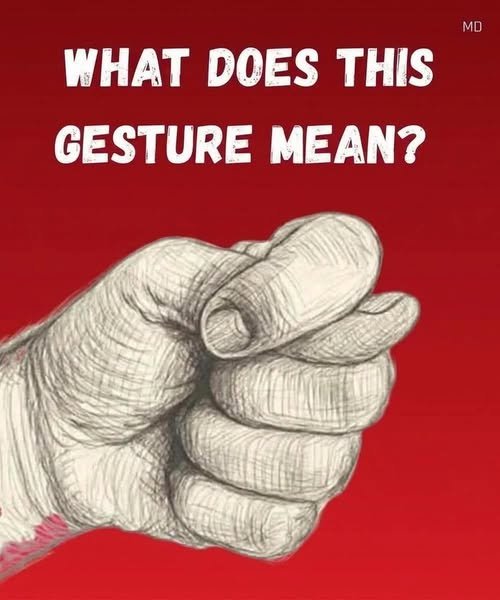
    Sensationalist viral posts frequently frame common body language as containing “hidden secrets” or ominous universal meanings to spark online speculation. The hand gesture depicted in the illustration—made by forming a fist and inserting the thumb between the index and middle fingers—is known historically as the fig sign (manoin fica or figa). Far from a single universal code, its meaning varies dramatically across different cultures, ranging from a playful children’s game to an apotropaic charm or a crude, vulgar insult depending on geographic location and historical context.

    Cultural Meanings Across Different Regions

    • The “I’ve Got Your Nose” Game: In North America and several Western nations, parents and children commonly use this gesture in a lighthearted pretend game where an adult “steals” a toddler’s nose, holding the protruding thumb tip to represent the captured nose.
    • Ancient Protection and Luck Symbol: Dating back to ancient Roman and Mediterranean antiquities, the figa gesture was considered an apotropaic talisman used to ward off the “evil eye,” jealousy, or bad fortune. In modern Brazil, wooden or stone charms shaped like this fist are widely worn as lucky amulets to bring good fortune.
    • Obscene or Dismissive Insult: In Eastern Europe, Turkey, Greece, and parts of the Mediterranean, the gesture is historically considered an offensive, vulgar sign expressing defiance, severe rejection, or a crude refusal equivalent to “you get nothing.”

    The Importance of Cultural Context

    Body language and hand gestures do not possess a single, immutable meaning across global societies. While internet graphics often hype these symbols to suggest secret societies or sinister hidden truths, the fig sign is simply an ancient hand symbol that evolved along multiple cultural paths over thousands of years. Understanding its diverse cultural interpretations prevents unnecessary misunderstandings and neutralizes viral clickbait claims.

  • This hand gesture is universally known as the “fig sign” (mano fico in Italian). Depending on the culture, it carries drastically different meanings:

    This hand gesture is universally known as the “fig sign” (mano fico in Italian). Depending on the culture, it carries drastically different meanings:

    • “I Got Your Nose”: In Western cultures (like North America and Northern Europe), adults use this gesture in a playful game with young children to pretend they have “stolen” their nose.
    • Obscene / Insulting Gesture: In Turkey, Greece, Russia, Slavic countries, and parts of the Mediterranean, it is a rude gesture equivalent to showing someone the middle finger. It expresses defiance, rejection, or a vulgar refusal (meaning “you get nothing” or “screw you”).
    • Protection Against the “Evil Eye”: Historically, in ancient Rome, Italy, Brazil, and Portugal, it served as an apotropaic charm—a good luck symbol used to ward off jealousy, bad luck, and evil spirits.
    • Ancient Origins: Dating back to classical antiquity, the gesture originally had an explicit phallic meaning, which is why it was thought to drive away evil energy or serve as a raw insult.

    Like many social media clickbait graphics, it promises a single “deep secret,” but in reality, its meaning depends entirely on where in the world you make it!

  • Identifying Vintage Novelties: Modular Brass Metal Smoking Pipes

    Identifying Vintage Novelties: Modular Brass Metal Smoking Pipes

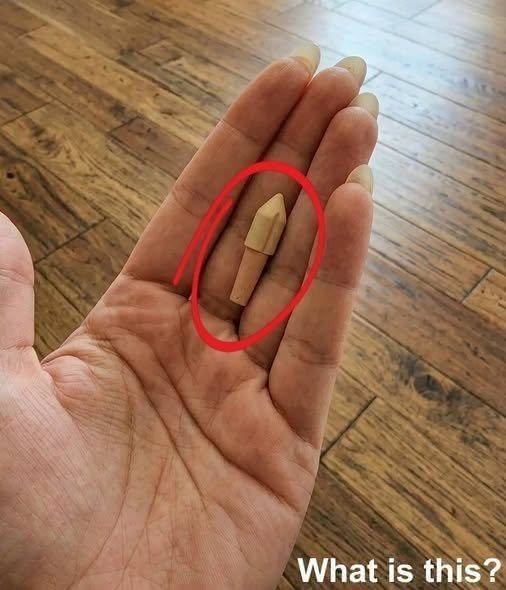
    Discovering an ornate, machined brass object in an old drawer often sparks curiosity, but the item pictured is a classic modular brass hand pipe (often referred to as a metal “screw-pipe” or novelty brass pipe). Popularized in the mid-to-late 20th century—particularly throughout the 1970s and 1980s—these compact metal pipes were widely manufactured and sold in tobacconists and novelty shops worldwide. Rather than an antique scientific instrument or specialized maritime tool, it is a mass-produced, functional smoking paraphernalia piece designed for personal tobacco or botanical use.

    Design Features and Construction Mechanics

    • Modular Screw-Together Assembly: Built entirely from machined brass parts, these pipes consist of interchangeable threaded components—including a small bowl, an elbow connector, a central stem body, and a decorative mouthpiece—that unscrew completely for easy cleaning and transport.
    • Knurled Bands and Rubber O-Rings: The ridged, knurled bands along the barrel provide an ergonomic grip, while the small black rubber rings (O-rings) fitted between the threaded joints create an airtight seal and keep the sections securely fastened during use.
    • Durable Metallic Composition: Solid brass was chosen by manufacturers for its high heat tolerance, corrosion resistance, and structural durability, allowing these small handheld pipes to survive decades in storage without breaking.

    Historical Context and Collector Value

    While their intricate knurling and weighted metal construction give them the appearance of vintage engineering tools or antique nautical instruments, these pipes remain common vintage novelties. Millions of variations were produced using similar turned-brass patterns, making them an interesting piece of mid-century counterculture design history rather than a high-value historical artifact.

  • Demystifying Social Etiquette: The “M” Line on RSVP Cards

    Demystifying Social Etiquette: The “M” Line on RSVP Cards

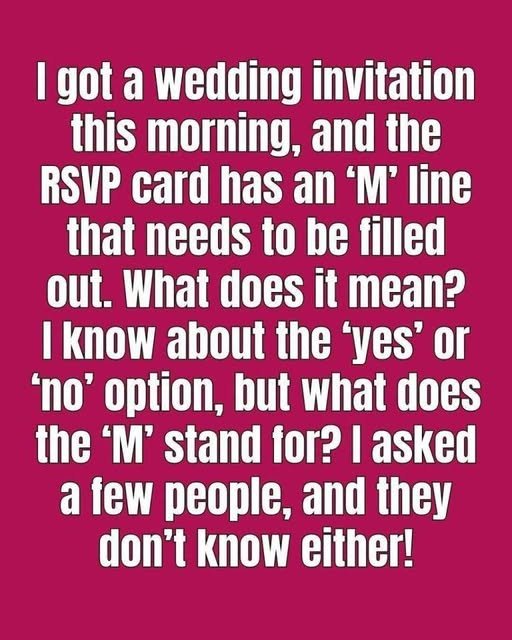
    Receiving a formal event or wedding invitation with a solitary “M” followed by a blank line often leaves guests thoroughly confused. Contrary to modern internet speculation that it stands for “Meal preference,” “Main guest,” or “Mandatory,” the “M” is a traditional etiquette prompt rooted in formal correspondence. It serves as the starting letter for your personal honorific title—such as Mr., Mrs., Ms., or Miss—guiding guests on how to properly write out their names for the host’s headcounts and place cards.

    How to Properly Fill Out the “M” Line

    • Single Attendees: Write your honorific title directly after the letter “M” and follow it with your full name (e.g., Ms. Jane Doe or Mr. John Smith).
    • Couples or Families: Fill in the appropriate titles for all attending guests in your party (e.g., Mr. and Mrs. John Smith or Ms. Jane Doe and Mr. Alan Poe).
    • Other Professional Titles: If you hold a title that does not start with “M” (such as Dr., Reverend, or Captain), you can simply cross out or ignore the printed “M” and write your correct title and full name alongside it.

    The Evolution of Modern RSVP Cards

    While classical stationery continues to print the traditional “M” line for formal aesthetics, modern invitation designers increasingly swap it out for clearer, less ambiguous language like “Name(s):” or “Guest Names.” Understanding this subtle piece of traditional social etiquette removes any guesswork, allowing guests to promptly reply to the hosts with confidence and clarity.

  • Demystifying Egg Discoloration: Thermal Reaction vs. Food Safety

    Demystifying Egg Discoloration: Thermal Reaction vs. Food Safety

    Sensationalist headlines and social media posts often feature incomplete warnings like “If your eggs have a green ring around the yolk, it means that…” to imply spoiled food, bacterial toxins, or chemical danger. These alarming prompts leverage food anxiety to farm clicks and shares. In kitchen science, a greenish-gray ring surrounding a hard-boiled egg yolk is an extremely common, harmless natural chemical reaction caused solely by overcooking or high cooking temperatures.

    The Science Behind the Green Ring

    • Iron-Sulfur Chemical Reaction: As an egg cooks, heat breaks down proteins in the egg white (albumen), releasing small amounts of hydrogen sulfide gas. When the egg is subjected to high heat or prolonged boiling, this gas migrates toward the center of the egg, where it reacts with the iron present in the yolk to form ferrous sulfide—a dark, greenish-gray compound.
    • Impact of Cooling Rates: Allowing hot eggs to sit in boiling water or cool slowly at room temperature encourages this chemical reaction to continue. Rapidly cooling cooked eggs in an ice water bath immediately stops the reaction, preserving a bright, uniform yellow yolk.
    • Completely Safe to Eat: While the slight sulfur reaction can subtly affect the egg’s texture and taste—making the yolk somewhat dry or chalky—ferrous sulfide is entirely non-toxic. Overcooked eggs with a green ring are 100% safe to consume.

    Culinary Techniques for Perfectly Boiled Eggs

    Avoiding the green ring is straightforward with precise boiling and cooling protocols. To prevent overcooking, place eggs in boiling water for 9 to 12 minutes depending on egg size, then immediately transfer them into a bowl filled with ice water for at least five minutes. Rapid chilling lowers the internal temperature quickly, stopping the migration of hydrogen sulfide gas and ensuring tender, vibrantly colored yolks every time.
  • Understanding Vascular Reactivity: Raynaud’s Phenomenon vs. Sensational Headlines

    Understanding Vascular Reactivity: Raynaud’s Phenomenon vs. Sensational Headlines

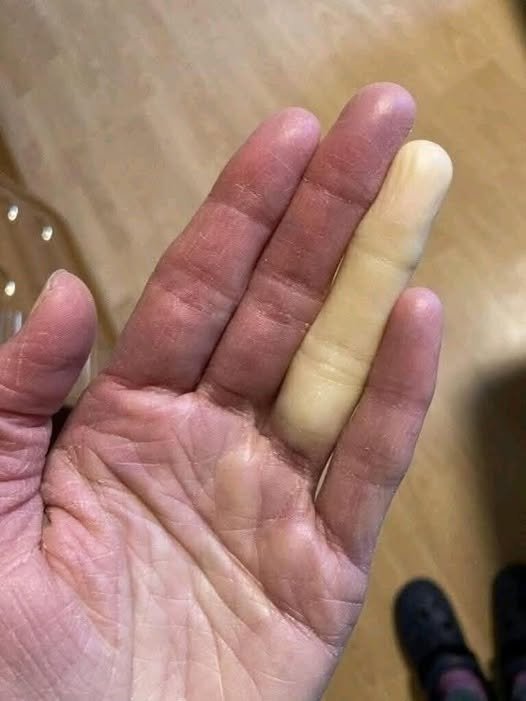
    Viral posts featuring dramatic images of starkly blanched or waxy-white fingers often append incomplete, ominous captions like “These are the consequences of sleeping with the…” to spread fear or attribute common medical symptoms to bizarre habits. In reality, the distinct pale discoloration visible on the ring finger in the photograph is a classic demonstration of Raynaud’s phenomenon. This vascular condition causes small blood vessels (capillaries) in the extremities to undergo temporary spasms, severely restricting blood flow in response to cold temperatures, emotional stress, or vibration—not strange nocturnal habits.

    Mechanisms and Triggers of Raynaud’s Attacks

    • Vaspasm and Blanched Skin: During an episode, small peripheral arteries rapidly constrict (vasospasm), temporarily cutting off oxygenated blood to individual digits. This results in a sharp, distinct boundary where the affected finger turns pale white or yellowish-wax.
    • Color Triphasic Shift: As blood oxygen depletes, the affected finger may turn blue or purple (cyanosis). Once the area rewarms or stress passes, blood vessels dilate, causing a red blush (erythema) accompanied by tingling, throbbing, or numbness.
    • Primary vs. Secondary Types: Primary Raynaud’s (Raynaud’s disease) is a common, benign condition occurring independently without an underlying illness, whereas Secondary Raynaud’s (Raynaud’s syndrome) is linked to underlying connective tissue disorders such as lupus, scleroderma, or rheumatoid arthritis.

    Managing Vasospasms and When to Seek Advice

    Attributing acute peripheral paleness to viral clickbait tropes distracts from straightforward medical management. Individuals experiencing Raynaud’s attacks can manage symptoms by wearing insulated gloves in cold environments, avoiding sudden temperature changes, quitting smoking (which further constricts blood vessels), and gently rewarming hands under warm water or in armpits during an active vasospasm. Consulting a primary care physician helps confirm the diagnosis and rule out underlying autoimmune factors.