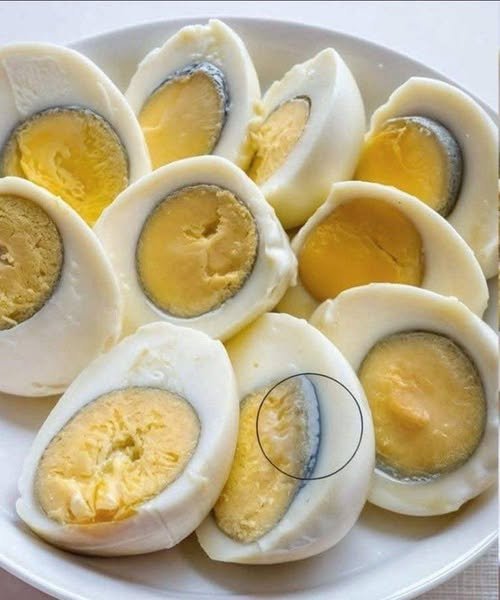
Sensationalist headlines and social media posts often feature incomplete warnings like “If your eggs have a green ring around the yolk, it means that…” to imply spoiled food, bacterial toxins, or chemical danger. These alarming prompts leverage food anxiety to farm clicks and shares. In kitchen science, a greenish-gray ring surrounding a hard-boiled egg yolk is an extremely common, harmless natural chemical reaction caused solely by overcooking or high cooking temperatures.
The Science Behind the Green Ring
- Iron-Sulfur Chemical Reaction: As an egg cooks, heat breaks down proteins in the egg white (albumen), releasing small amounts of hydrogen sulfide gas. When the egg is subjected to high heat or prolonged boiling, this gas migrates toward the center of the egg, where it reacts with the iron present in the yolk to form ferrous sulfide—a dark, greenish-gray compound.
- Impact of Cooling Rates: Allowing hot eggs to sit in boiling water or cool slowly at room temperature encourages this chemical reaction to continue. Rapidly cooling cooked eggs in an ice water bath immediately stops the reaction, preserving a bright, uniform yellow yolk.
- Completely Safe to Eat: While the slight sulfur reaction can subtly affect the egg’s texture and taste—making the yolk somewhat dry or chalky—ferrous sulfide is entirely non-toxic. Overcooked eggs with a green ring are 100% safe to consume.
Culinary Techniques for Perfectly Boiled Eggs
Avoiding the green ring is straightforward with precise boiling and cooling protocols. To prevent overcooking, place eggs in boiling water for 9 to 12 minutes depending on egg size, then immediately transfer them into a bowl filled with ice water for at least five minutes. Rapid chilling lowers the internal temperature quickly, stopping the migration of hydrogen sulfide gas and ensuring tender, vibrantly colored yolks every time.
Leave a Reply