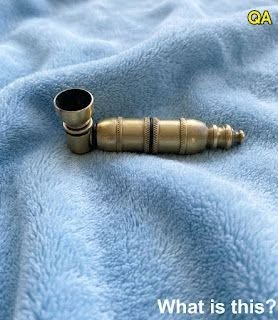
Discovering an ornate, machined brass object in an old drawer often sparks curiosity, but the item pictured is a classic modular brass hand pipe (often referred to as a metal “screw-pipe” or novelty brass pipe). Popularized in the mid-to-late 20th century—particularly throughout the 1970s and 1980s—these compact metal pipes were widely manufactured and sold in tobacconists and novelty shops worldwide. Rather than an antique scientific instrument or specialized maritime tool, it is a mass-produced, functional smoking paraphernalia piece designed for personal tobacco or botanical use.
Design Features and Construction Mechanics
- Modular Screw-Together Assembly: Built entirely from machined brass parts, these pipes consist of interchangeable threaded components—including a small bowl, an elbow connector, a central stem body, and a decorative mouthpiece—that unscrew completely for easy cleaning and transport.
- Knurled Bands and Rubber O-Rings: The ridged, knurled bands along the barrel provide an ergonomic grip, while the small black rubber rings (O-rings) fitted between the threaded joints create an airtight seal and keep the sections securely fastened during use.
- Durable Metallic Composition: Solid brass was chosen by manufacturers for its high heat tolerance, corrosion resistance, and structural durability, allowing these small handheld pipes to survive decades in storage without breaking.
Historical Context and Collector Value
While their intricate knurling and weighted metal construction give them the appearance of vintage engineering tools or antique nautical instruments, these pipes remain common vintage novelties. Millions of variations were produced using similar turned-brass patterns, making them an interesting piece of mid-century counterculture design history rather than a high-value historical artifact.
Leave a Reply