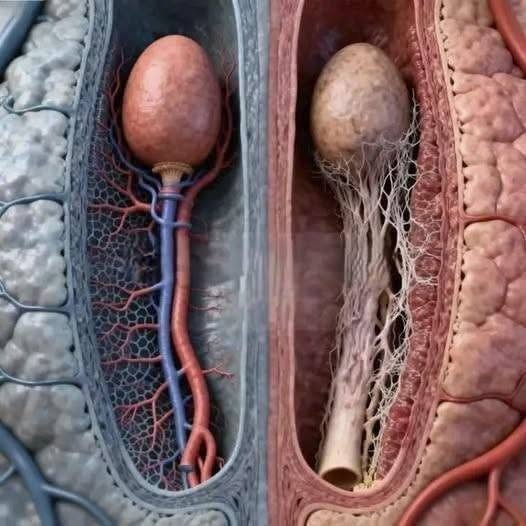
The split image presents a stylized 3D rendering showing two egg-shaped structures attached to complex vessel networks within bodily cavities—one side highlighting smooth vascular branching and the other displaying a dense, fibrous web. It is paired with an incomplete, provocative prompt: “Did you know that old men have the pe…”
Despite the attempt to frame this graphic as a medical comparison of male anatomy or age-related biological changes, this diagram is entirely synthetic and anatomically inaccurate.
Anatomical Misconceptions in the Graphic
- Non-Biological Renderings:
- The structures depicted do not accurately represent real human male anatomy, testicles, blood vessels, or tissue layers.
- Testicular anatomy consists of seminiferous tubules, epididymis, vas deferens, and specific arterial/venous plexus networks (pampiniform plexus), none of which resemble the smooth “egg-on-a-stem” or fibrous column designs rendered here.
- Misrepresented Aging Processes:
- While aging in men involves gradual hormonal shifts (such as a decrease in serum testosterone) and potential changes in vascular elasticity or microcirculation, it does not cause internal organs to transform into skeletal or webbed fiber structures as suggested by the right panel.
- Digital CGI & Stock Art Origins:
- Images like these are routinely generated using 3D rendering software or generative AI models designed to look superficially “scientific” while fabricating non-existent biological phenomena.
Deconstructing Medical Misinformation Tactics
This post follows a well-established clickbait formula commonly used by engagement-farming pages:
- The Truncated Prompt (“Curiosity Gap”): Cutting off the text mid-sentence (“Did you know that old men have the pe…”) creates an intentional mystery, tricking scrollers into opening the post or checking the comments to finish the sentence.
- Pseudo-Scientific Visuals: Using high-detail 3D medical style renderings tricks viewers into mistaking artificial CGI graphics for legitimate clinical research or anatomical textbooks.
- Algorithmic Engagement Harvesting: Frightened, confused, or curious users flooding the comment section to debate what the image represents boosts the post’s visibility across social media recommendation engines.