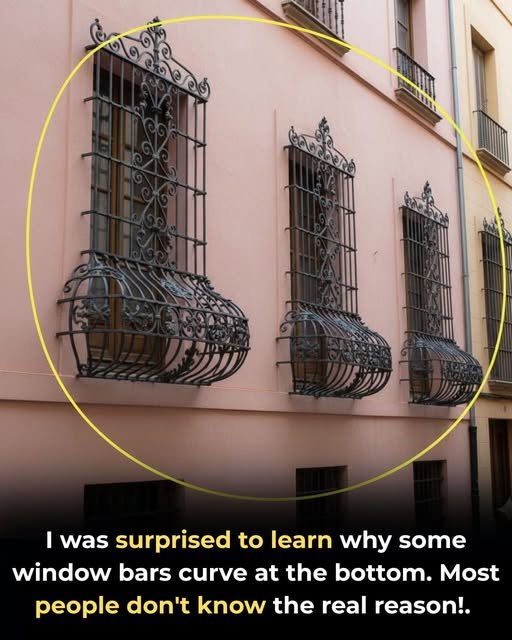
The image shows a building façade featuring wrought-iron security bars on windows, encircled in yellow, with a prominent bulged or belly-like curve extending outward near the bottom. The overlay claims: “I was surprised to learn why some window bars curve at the bottom. Most people don’t know the real reason!”
These curved wrought-iron grills—traditionally known in Spanish architecture as rejas buche (or “puffed-belly” window bars)—are a functional and historical feature found throughout Southern Europe, Latin America, and Mediterranean regions.
The Practical Reasons for Curved Window Bars
While ornamental blacksmithing certainly added aesthetic charm, the outward curve was engineered for specific practical uses:
- Flower Pots and Window Boxes:
- The outward bulge provides a sturdy, secure platform to place flower pots, potted herbs, or decorative plants directly outside the window pane without them taking up interior floor space or falling onto the street below.
- Ventilation and Shutters:
- Traditional European windows used exterior wooden shutters that opened outward. The curved iron cage gave residents room to push open their wooden shutters or reach out to secure them without hitting the security bars.
- Sightlines and Social interaction:
- In historical urban housing, these “belly bars” allowed residents (particularly women working inside or looking out onto the street) to lean forward and look down the alleyway in both directions to see who was passing by, rather than having their view restricted straight ahead by flat vertical bars.
- Security with Extra Space:
- Flat security grates can make room interiors feel enclosed and cramped. The outward curve creates an illusion of depth and extra space while still maintaining a robust, intruder-proof barrier over ground-floor or low-balcony windows.
Deconstructing “Hidden Architecture” Clickbait
This post relies on a standard engagement-farming template designed to turn basic architectural history into an intriguing secret:
- The “Secret Knowledge” Hook: Claiming that “Most people don’t know the real reason” triggers a fear-of-missing-out (FOMO) reaction, nudging scrollers to pause.
- Visual Circle Cue: Drawing a massive bright yellow circle around the obvious main subject forces the viewer’s eye to lock onto the image and analyze the shape.
- Comment-Section Crowdsourcing: Because thousands of people have seen these bars in Spain, Italy, Mexico, or New Orleans, hundreds jump into the comments to post their own theories, regional names, or travel stories. This massive comment volume signals high engagement to platform algorithms, boosting the post to a wider audience.
Leave a Reply