Blog

  • Identifying Bathroom Intruders: What to Know and Do

    Identifying Bathroom Intruders: What to Know and Do

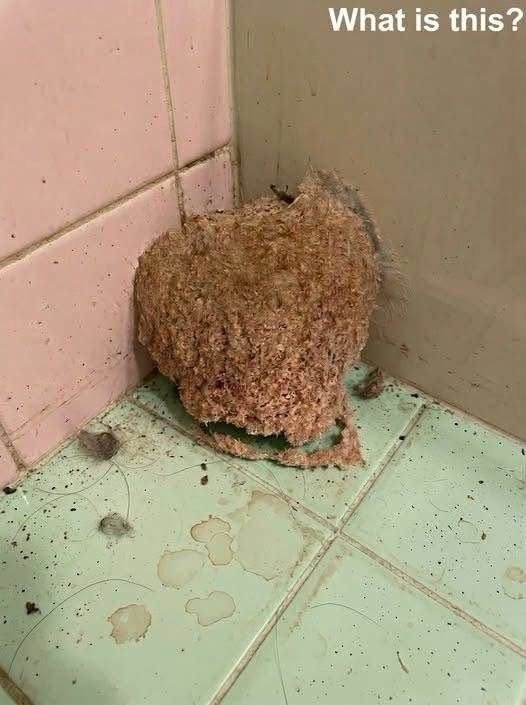
    The object in the corner appears to be a rodent nest (likely built by mice or rats) made from torn insulation material, lint, hair, and gathered debris. When a house remains dark, quiet, and unoccupied for a week, rodents often take advantage of the undisturbed environment to build sheltered nests close to water sources like drains or pipes.

    These nests present multiple safety and sanitation concerns. Beyond harboring bacteria, parasites, and airborne pathogens associated with rodent waste, these structures can cause hidden damage inside walls or cabinets where insulation was pulled. Furthermore, if rodents gnaw through electrical wiring behind tile or wall voids, it creates a potential fire risk.

    To safely resolve this issue, follow these steps:

    1. Wear Protection: Put on heavy rubber or nitrile gloves and an N95 respirator mask before approaching the area to avoid inhaling airborne particles.
    2. Disinfect First: Spray the entire nest and surrounding tile thoroughly with a household disinfectant or diluted bleach solution; never vacuum or sweep it dry, as this disperses contaminants into the air.
    3. Safe Disposal: Carefully scoop the damp nest into a heavy-duty plastic trash bag, seal it tightly, place it inside a second sealed bag, and dispose of it outdoors.
    4. Sanitize & Inspect: Deep-clean the area with disinfectant, then inspect lower cabinets, baseboards, and pipe entries to seal any gaps larger than a pencil eraser with steel wool and caulk.
  • Understanding Sudden Skin Reactions: Causes and Care

    Understanding Sudden Skin Reactions: Causes and Care

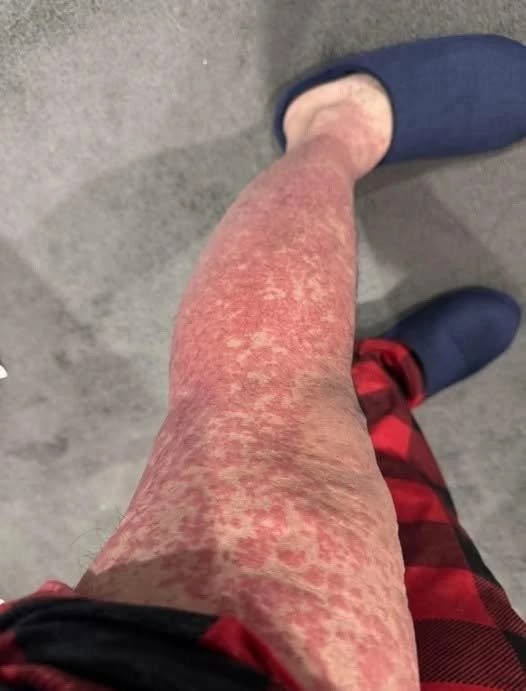
    A widespread, sudden rash like the one pictured—characterized by numerous red, potentially raised, and confluent patches across the limbs—often indicates an acute systemic reaction. This is very different from a localized insect bite. Common causes for such an extensive skin eruption can include an acute allergic reaction (hives or urticaria) to a new medication, food, or environmental exposure. Viral or bacterial infections can also trigger widespread rashes. Importantly, certain serious conditions can also present this way.

    When a rash is this severe, extensive, or accompanied by other symptoms, it is critical to seek medical evaluation promptly. Do not attempt to self-diagnose or treat the rash yourself. A healthcare professional, such as a doctor or dermatologist, is needed to perform a proper physical examination, take a detailed medical history, and order relevant tests (like blood work or a skin biopsy) to determine the underlying cause and recommend appropriate treatment.

    You should seek immediate medical attention, potentially in an emergency department, if the rash spread very rapidly or is accompanied by any of these high-risk “red flag” signs:

    • Difficulty breathing or a feeling of throat swelling
    • Fever, chills, or body aches
    • Blistering of the skin or peeling that leaves open sores
    • The rash involves mucous membranes (mouth, eyes, genitals)
    • The rash is painful to the touch (rather than itchy)
    • The red spots do not blanch (fade temporarily) when you press on them
  • Deconstructing Gastrointestinal Panic Clickbait: The Cartoon Stool Infographic

    Deconstructing Gastrointestinal Panic Clickbait: The Cartoon Stool Infographic

    The image features anthropomorphic cartoon characters depicting stool shapes labeled “NORMAL,” “ALSO NORMAL,” and “BAD,” combined with an aggressive headline: “5 Alarming Red Flags That Scream Colon Cancer Might Be Present.” A downward arrow prompts viewers toward the “Full Story Below.” This graphic represents a quintessential health anxiety and bowel panic engagement template designed to monetize visceral self-diagnosis fears.

    Anatomy of the Science & Clickbait Strategy

    • The Medical Reality (Bristol Stool Chart Simplified): Gastroenterology evaluates digestive health using the standardized Bristol Stool Chart. While subtle variations in shape or pencil-thin stool (as vaguely hinted at under the “BAD” column) can occasionally indicate a partial blockage or stricture in the colon, attributing minor visual stool changes primarily to cancer is a gross oversimplification. Stool consistency and shape fluctuate daily based on dietary fiber, hydration, stress, and gut motility.
    • Cancer-Fearing Fearmongering: Cancer is one of the most effective triggers for emotional hijacking on social media. Using sensationalized vocabulary like “Alarming Red Flags That Scream” bypasses critical thinking and induces immediate health paranoia, encouraging users to click for self-reassurance.
    • Cartoon Gamification of Health: Rendering bodily waste as smiling, sunglasses-wearing cartoon characters lowers the barrier to entry for sensitive or taboo medical topics. It makes the graphic visually engaging and shareable while trivializing actual diagnostic criteria.
    • The “Full Story Below” Comment Trap: The graphic deliberately withholds the actual list of five symptoms. Placing a call-to-action pointing to the comment section forces users to open the comments, where a pinned link redirects traffic to an ad-heavy health blog or pseudo-medical site.
    • Algorithmic Monetization: Health scares produce high volumes of tagged friends, panic comments, and bookmarking. Social media algorithms reward this rapid engagement, boosting the page’s overall reach to maximize ad impression revenue.
  • Deconstructing Emotional Curiosity Bait: The NICU Purple Butterfly

    Deconstructing Emotional Curiosity Bait: The NICU Purple Butterfly

    The image shows a newborn baby in a hospital cot with a purple butterfly sticker circled in red, overlaid with the high-contrast text: “IF YOU SEE A PURPLE BUTTERFLY STICKER NEAR A NEWBORN BABY, YOU NEED TO KNOW WHAT IT MEANS.” This graphic represents an emotional clickbait template that takes a genuine, sensitive healthcare initiative and turns it into a sensationalized cliffhanger to drive social media interactions.

    Anatomy of the Symbol & Clickbait Strategy

    • The Real-World Origin: The purple butterfly is an actual medical awareness symbol created by The Butterfly Project (founded by Millie Smith after losing one of her twin daughters, Skye, in the NICU). In participating hospitals, placing a purple butterfly on a baby’s cot or door signifies that the infant was part of a multiple birth (twins, triplets, etc.) where one or more siblings did not survive. It serves as a subtle indicator for staff and visitors to speak with sensitivity and avoid asking standard questions like, “Are they a twin?”
    • The Curiosity-Gap Weaponization: While the symbol carries a deep, poignant healthcare function, the meme format deliberately withholds the explanation behind bold, yellow text. By creating an artificial mystery (“YOU NEED TO KNOW WHAT IT MEANS”), it forces viewers to interact with the post to find the answer.
    • Emotional Engagement Farming: Topics involving neonatal loss, hospital care, and grief trigger intense feelings of sympathy and curiosity. Content networks exploit these delicate topics knowing they generate thousands of comments from parents sharing condolences or personal NICU stories.
    • Monetization Funnel: The post uses the solemnity of hospital care as engagement bait. The resulting surge in shares and comments signals high algorithm priority, allowing page operators to funnel traffic toward monetized link hubs, ad-heavy blogs, or sensational click-farms.
  • Deconstructing Household Fear Clickbait: The Kitchen Appliance Fire Trap

    Deconstructing Household Fear Clickbait: The Kitchen Appliance Fire Trap

    The image depicts electrical cords bursting into flames at a wall outlet, accompanied by dramatic text stating, “Before going to sleep, there is one kitchen appliance that you must unplug at all costs to avoid a fire!” This graphic represents a classic household safety fear-mongering template engineered to turn basic fire safety concepts into an urgent, cliffhanger mystery.

    Anatomy of the Risk & Clickbait Strategy

    • The Reality of Appliance Safety: While fire safety experts do recommend turning off or unplugging high-wattage heating appliances—such as toasters, toaster ovens, coffee makers, and air fryers—when not in use, framing a single mystery appliance as something you must unplug “at all costs” exaggerates standard home maintenance. Modern appliances are built to strict safety standards, and electrical fires are typically caused by damaged cords, overloaded extension cords, or internal short circuits, rather than simply leaving a functional appliance plugged in overnight.
    • Artificial Curiosity Gap: By withholding the name of the “one kitchen appliance,” the post relies on anxiety to force readers to click “See More” or search through the comment section to find out if their home is at risk.
    • Shock Value Visuals: Using dramatic stock photos or AI renderings of burning electrical outlets sparks immediate household panic, ensuring the post stands out in busy social feeds.
    • Algorithmic Monetization: Posts that tap into home safety and life-threatening scenarios yield high share counts as users attempt to “warn” family members. Content networks leverage this artificially boosted reach to drive traffic toward ad-heavy blogs, affiliate pages selling surge protectors, or viral click-farms.
  • Deconstructing Home Remedy Clickbait: The Bedbug Cure Grid

    Deconstructing Home Remedy Clickbait: The Bedbug Cure Grid

    The image features a four-panel grid combining macro shots of bedbugs (Cimex lectularius), a dirty mattress seam, a rash-covered back overlaid with a daisy flower, and a hand holding whole cloves. It is accompanied by the headline “Dealing With Bedbugs? Here’s How to Identify and Remove Them Effectively…” This graphic represents a classic household anxiety and natural cure engagement template designed to sell pseudoscience solutions for complex pest infestations.

    Anatomy of the Misinformation & Clickbait Strategy

    • The Ineffective “Natural Cure” Myth: The inclusion of cloves and daisies pushes a widespread internet myth that home remedies—specifically essential oils like eugenol (found in cloves) or pyrethrin-like extracts—can easily eradicate a bedbug infestation. While concentrated clove oil can kill individual bugs on direct contact, it has zero residual effect, cannot penetrate eggs, and will not eliminate a systemic, hidden infestation.
    • Sensationalized Imagery: Combining severe rash photos (censored or visual-masked with a daisy flower) alongside clustered pests triggers both disgust and household hygiene anxiety.
    • The Pseudoscience Funnel: Pages post these infographics to target distressed homeowners looking for quick, cheap, chemical-free solutions. The text hook leads to ad-heavy blogs or affiliate pages selling “miracle” herbal sprays that fail to solve the pest issue.
    • Algorithmic Monetization: Desperate users save, share, and comment heavily on pest control posts to ask for advice. Content networks exploit this high-engagement topic to boost page visibility and direct traffic to monetized sites.
  • Deconstructing Biological Mystery Clickbait: The False Centipede / Eyelash Trap

    Deconstructing Biological Mystery Clickbait: The False Centipede / Eyelash Trap

    The image displays a strange, curved organism placed on a paper towel, featuring a fleshy pink body with feather-like, brownish spines or appendages radiating outward. It is paired with a classic crowd-sourcing story: “My girlfriend came home after a walk with the dog. Attached to the dog’s fur, we discovered this… Does anyone know what this is?” This post is a prime example of an alien-creature / parasite panic template engineered to exploit biological disgust and curiosity.

    Anatomy of the Object & Strategy

    • Identification: The object shown is actually a pair of strip false eyelashes coated in dried makeup, liquid latex adhesive, or debris, placed curve-side up on paper towel tissue. When individual hair fibers stick together and curl after being discarded or wet, the flexible band resembles a pinkish spine or fleshy centipede-like parasite.
    • Fabricated Narrative: The “dog walk” backstory is completely manufactured. By framing a mundane, discarded cosmetic item as a strange parasite attached to a pet’s fur, the post creates immediate concern for animal safety and triggers revulsion toward potential parasites.
    • Crowdsourced Identification Trap: Posting an unidentifiable, unsettling object and asking “What is this?” leverages collective mystery. Viewers are driven to comment with guesses ranging from sea creatures to alien worms, while others step in to reveal that it is simply a dirty fake eyelash.
    • Algorithmic Monetization: High-volume debates in the comment section—where users argue over whether it is an insect, a sea worm, or a beauty product—signal massive user interaction to platform algorithms. Content farms use this engagement boost to build follower bases and route traffic toward monetized link hubs.
  • Deconstructing Ego-Bait Trivia Clickbait: The “WC” Restroom Sign

    Deconstructing Ego-Bait Trivia Clickbait: The “WC” Restroom Sign

    The image displays a public restroom sign with the letters “WC” above male and female pictograms, accompanied by the text: “Most people still don’t know what the acronym ‘WC’ used in restrooms stands for.” A red arrow points down to a call to action: “See full story in the first comment.” This graphic represents a classic ego-baiting trivia engagement template engineered to exploit minor gaps in general knowledge to farm comments and link clicks.

    Anatomy of the Acronym & Clickbait Strategy

    • The Factual “Answer”: WC stands for Water Closet. The term originated in late 19th-century Britain during the invention of indoor flush toilets. It was used to distinguish a room with an actual water-flushed toilet from traditional dry outhouses, chamber pots, or “earth closets.” While the phrase has mostly fallen out of daily spoken English in North America, the abbreviation remains a universal international standard for public restroom signage across Europe and Asia.
    • Ego-Bait Strategy: Pretending that basic or historical acronyms are “secret knowledge” (“yet no one seems to know…”) relies on superior-feeling psychology. Viewers who do know what WC stands for are immediately motivated to comment to prove their knowledge or correct the post’s premise.
    • The “First Comment” Funnel: Notice the call-out directing users to the “first comment.” By suppressing the direct explanation in the main post, page operators force users to scroll into the comment section. There, a pinned link redirects traffic to a third-party, ad-heavy blog monetized through impressions and affiliate networks.
    • Algorithmic Monetization: High comment volumes generated by thousands of users typing “Water Closet” signal strong relevance to social media algorithms, artificially boosting the post’s distribution.
  • Deconstructing Emotional Curiosity Clickbait: The Hospice Chef Mystery

    Deconstructing Emotional Curiosity Clickbait: The Hospice Chef Mystery

    vThe image features a chef working in a commercial kitchen next to an inset photo of hands holding, overlaid with text stating, “CHEF WHO PREPARES LAST MEALS AT HOSPICE FOR PEOPLE AT END OF LIVES SAYS THEY OFTEN WANT SAME THING.” This graphic represents an emotionally charged curiosity-gap template designed to leverage human sentimentality about end-of-life moments for social media reach.

    Anatomy of the Human-Interest Story & Clickbait Strategy

    • The Real-World Origin: The chef pictured is Gareth O’Hara, head chef at Hartlands Hospice in the UK. In viral interviews, he shared that rather than demanding elaborate gourmet dishes, hospice patients overwhelmingly request simple, nostalgia-rich comfort foods from their childhoods. The single most common request mentioned in these profiles is traditional rice pudding, alongside simple childhood favorites like egg and chips or stew.
    • The Curiosity-Gap Trap: By concealing the specific food (“the one comfort food” / “says they often want same thing”), the headline creates an artificial mystery. Readers are driven by emotional empathy and curiosity to figure out what item connects so many people in their final days.
    • Sentimentality as Engagement Fuel: Topics touching on mortality, nostalgia, and human connection trigger strong emotional responses. Viewers frequently share these posts accompanied by personal stories about their late loved ones’ favorite foods, flooding the comment section with high-engagement stories.
    • Algorithmic Monetization: Content networks repurpose genuine, moving human-interest stories by stripping out the direct answer and turning them into cliffhangers. The resulting surge in shares and comments boosts the page’s algorithmic reach, allowing administrators to monetize user attention via ad-heavy click-through sites.
  • Deconstructing Produce Fear Clickbait: The “Hollow Heart” Watermelon Trap

    Deconstructing Produce Fear Clickbait: The “Hollow Heart” Watermelon Trap

    The image shows a cut-open watermelon with internal cracks and a hollow center marked by a white arrow, accompanied by a alarming hook: “You cut open a watermelon and saw cracks? Stop eating it immediately! Here’s what it means.” This graphic is a classic food-panic engagement template that frames a natural plant growth condition as a dangerous health threat to generate clicks.

    Anatomy of the Condition & Clickbait Strategy

    • The Scientific Reality (Hollow Heart): Internal cracking in watermelons is caused by a physiological condition known as hollow heart. It is primarily triggered by inadequate or poor pollination early in the growing season (often due to cold, rainy weather slowing down bee activity), followed by sudden growth spurts from fluctuating temperatures or watering.
    • Safe to Eat: Hollow heart is purely an aesthetic defect. The watermelon is completely safe to eat and is not toxic. In fact, watermelons with hollow heart often taste sweeter because natural sugars concentrate along the edges of the internal cracks.
    • The “Chemical/Toxin” Myth: Internet rumors frequently claim internal cracks are caused by harmful growth chemicals (like forchlorfenuron) or toxic injections. While growth regulators caused exploding crops in China over a decade ago, internal hollow heart in commercially available watermelons is a natural pollination failure, not chemical contamination.
    • Alarmist Framing: Using imperative commands like “Stop eating it immediately!” creates artificial urgency and panic, driving users to share the post or click external links out of health anxiety.