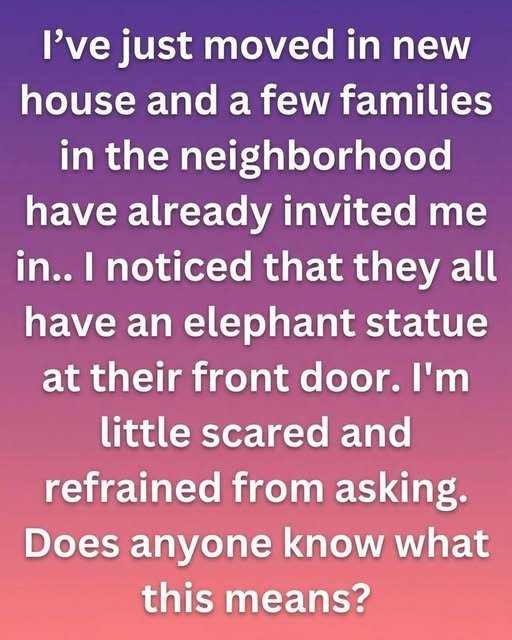
The graphic displays a text-based story on a gradient background with the headline: “The Hidden Meaning Behind an Elephant Statue at the Front Door”. The post narrative claims: “I’ve just moved in new house and a few families in the neighborhood have already invited me in.. I noticed that they all have an elephant statue at their front door. I’m little scared and refrained from asking. Does anyone know what this means?”
Despite the sensationalized framing implying a sinister neighborhood secret, placing an elephant statue near a doorway is a traditional, centuries-old practice rooted in Feng Shui, Vastu Shastra, and global cultural symbolism symbolizing protection, prosperity, and good fortune.
The Real Cultural Meaning of Elephant Statues
- Feng Shui and Energy Flow (Chi):
- In traditional Chinese Feng Shui, elephants are revered as symbols of power, wisdom, protection, and fertility.
- Trunk Up vs. Trunk Down: An elephant with its trunk pointed upward is believed to absorb and attract good luck, wealth, and positive energy into the home. Placing one facing inward near the main entrance invites prosperity inside. An elephant with its trunk down is associated with grounding energy, longevity, and stability.
- Protectors of the Home: Placing a pair of elephant statues outside or beside the front entrance serves as symbolic “guardians” to ward off negative energy and protect the household.
- Vastu Shastra and Hindu Symbolism:
- In Indian Vastu Shastra and Hindu tradition, elephants are closely associated with Ganesha (the deity of new beginnings, wisdom, and the remover of obstacles) and Gaja Lakshmi (the goddess of wealth).
- Displaying an elephant statue at the threshold welcomes success, stability, and spiritual blessing into a new home.
- General Interior Decor and Hospitality:
- Beyond spiritual practices, elephant decor is widely popular globally simply as an aesthetic design element signifying strength, peace, and welcoming hospitality.
Deconstructing the “Secret Neighborhood” Paranoia Clickbait
This post relies on a classic engagement-farming template designed to turn harmless home decor into an artificial mystery:
- Manufactured Anxiety: Expressing fear over a common household item (“I’m little scared and refrained from asking”) creates an artificial emotional hook.
- Neighborhood “Subculture” Urban Legends: Clickbait creators frequently post fake “neighborhood warning” stories (e.g., claiming pineapples, specific porch light colors, or animal statues are “secret signals” for swingers or illicit groups) to provoke gossip.
- Comment Section Traps: Asking “Does anyone know what this means?” guarantees thousands of replies from people eager to share genuine cultural facts, make jokes, or debate urban legends.
- Algorithmic Boost & Traffic Routing: The flood of responses signals high user interest to platform algorithms. Pinned comments on these posts typically link to ad-saturated blog posts or monetization pages.
Leave a Reply