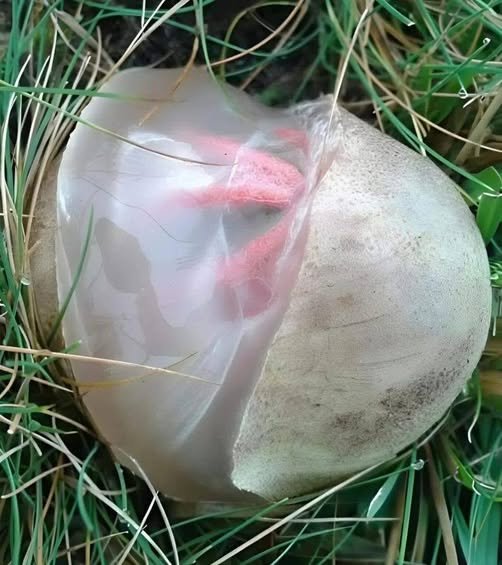
The gelatinous, alien-like structure pictured in your garden is the immature “egg” stage of a stinkhorn fungus, most likely belonging to species such as Clathrus archeri (Devil’s Fingers) or Mutinus elegans. Before bursting open into their fully formed, striking adult shapes, stinkhorns grow inside a protective, sac-like volva filled with a thick, jelly-like substance. Once conditions are right, the outer membrane ruptures, expanding rapidly into red or orange arm-like structures covered in a sticky, spore-bearing slime known as gleba.
The overwhelming, foul smell associated with these fungi is an essential evolutionary adaptation rather than a sign of toxic airborne danger. The gleba emits a potent odor resembling rotting meat or sewage specifically to attract flies, beetles, and other carrion-feeding insects. These insects land on the fungus to feed on the slimy coating, unwittingly picking up spores on their legs and bodies and dispersing them throughout the surrounding soil and garden ecosystem.
While the intense stench can easily induce nausea, gagging, or physical discomfort, stinkhorn fungi are non-toxic and present no chemical hazard to humans, pets, or garden plants. If you wish to remove them, wear disposable gloves to carefully dig up the gelatinous base and surrounding soil, then place the fungus in a sealed trash bag to prevent spores from spreading. Alternatively, applying a light dusting of garden lime or simply letting the fungus complete its brief 24-to-48-hour lifecycle will allow it to naturally decompose and vanish
Leave a Reply