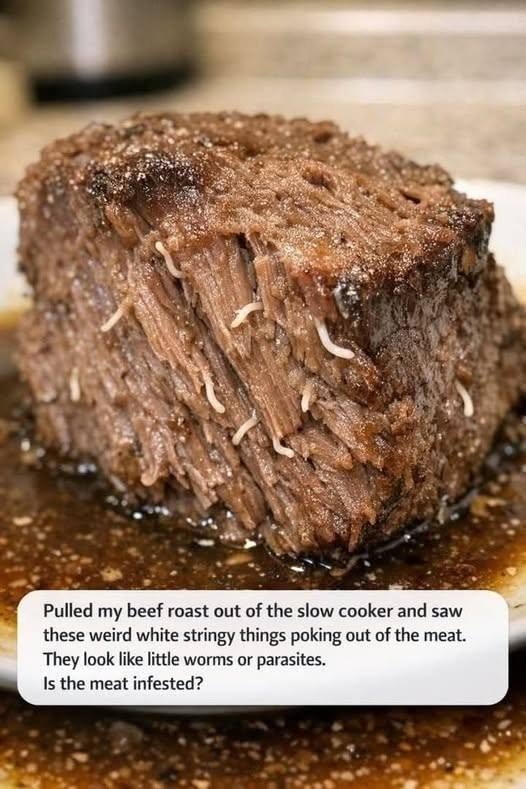
The image shows a pot roast with small, white, tubular strings protruding from between the muscle fibers, paired with the panic-inducing question: “Is the meat infested?”
The meat is not infested. What you are seeing are small, natural blood vessels, collagen strands, or nerve sheaths—a completely normal part of mammalian muscle anatomy that becomes visible after slow cooking.
What Are These White Strings?
- Blood Vessels (Arteries and Veins): Meat is muscle tissue, which requires a dense network of blood vessels to function. In life, these vascular tubes are flexible and dark, but extended cooking breaks down the surrounding proteins, causing these hollow collagenous tubes to shrink, firm up, and turn pale or white against the darker, rendered muscle fibers.
- Intramuscular Connective Tissue: Cuts used for slow cooking (like chuck roast or brisket) are rich in collagen and connective tissue sheaths (perimysium) that wrap around muscle bundles. As the roast cooks and the muscle contracts, these tougher structural fibers do not dissolve instantly, causing them to squeeze out or poke through the tender meat fibers.
- Heat Sterilization Realities: Parasites or worms found in raw meat (such as Trichinella or tapeworm cysts) are microscopic or look like small nodular cysts—they do not survive or remain intact as pristine white “worms” after hours in a slow cooker at temperatures well above $160^\circ\text{F}$ ($71^\circ\text{C}$).
Deconstructing Food-Disgust Clickbait Mechanics
This image is a widely circulated example of gross-out engagement bait designed to exploit food safety paranoia and disgusting visual triggers:
- Visceral Disgust Trigger: Featuring an image that mimics parasitic worms or maggots instantly triggers a strong disgust response, causing scrollers to pause out of shock.
- False Panic Formatting: Framing a standard culinary occurrence as a potential “infestation” encourages viewers to argue, reassure, or express disgust in the comment section.
- Virality via Debate: High volumes of comments asking “What is that?!” or wrongly identifying it as worms trick platform algorithms into pushing the image to millions of feeds, driving traffic to monetized pages or link trees.
Your roast is completely safe to eat—those white tubes are simply a natural part of beef anatomy exposed by the braising process.
Leave a Reply