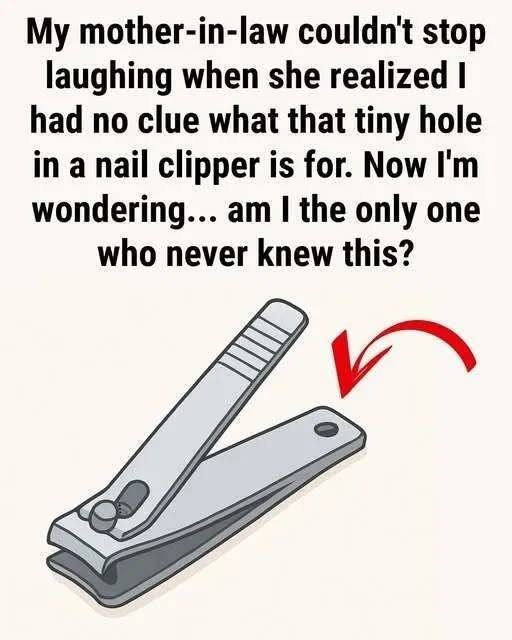
The graphic displays a standard pair of fingernail clippers with a red arrow pointing to the small hole at the non-cutting base. The overlay headline presents a familiar social media narrative: “My mother-in-law couldn’t stop laughing when she realized I had no clue what that tiny hole in a nail clipper is for. Now I’m wondering… am I the only one who never knew this?”
While clickbait posts attempt to frame this hole as a “hidden trick” or secret household hack, its actual functions are simple, practical manufacturing and storage features.
What the Hole Is Actually For
- Keychain Attachment & Portability:
- The primary user-facing purpose of the hole is to allow a small ball chain, keyring, or lanyard to pass through. This makes it easy to attach clippers to a toiletry bag, keyring, or travel kit so they do not get lost at the bottom of a bag.
- Assembly and Manufacturing Alignment:
- During the industrial stamping and electroplating process, machines use these small holes to align, hold, and transport the metal base components along factory conveyor lines.
- Hanging the raw metal pieces by this hole allows protective coatings (like nickel or chrome plating) to adhere evenly without leaving unplated grip marks.
- Retail Display and Storage:
- In retail environments or home organization racks, the hole enables clippers to be hung individually on pegboard hooks or wire displays without requiring bulky blister packaging.
Deconstructing the “Hidden Feature” Clickbait Formula
This post uses a textbook combination of viral engagement tactics:
- Relatable Household Object: Choosing an everyday item almost everyone owns guarantees maximum audience reach and familiarity.
- The “Pinned Comment” Redirect: The caption “More details in the comments below” is a classic redirection mechanism. The poster pins a link leading to an ad-heavy website, a multi-page slideshow, or a affiliate store, monetizing the curiosity of scrollers looking for the “secret”.
- Artificial Mockery / Family Drama: Framing the realization around a laughing mother-in-law creates an artificial emotional hook designed to make the reader feel out of the loop or validated.
- Comment-Driven Algorithmic Reach: Prompting “am I the only one who never knew this?” encourages thousands of users to comment with their own guesses, boosting the post’s organic distribution across news feeds.
Leave a Reply