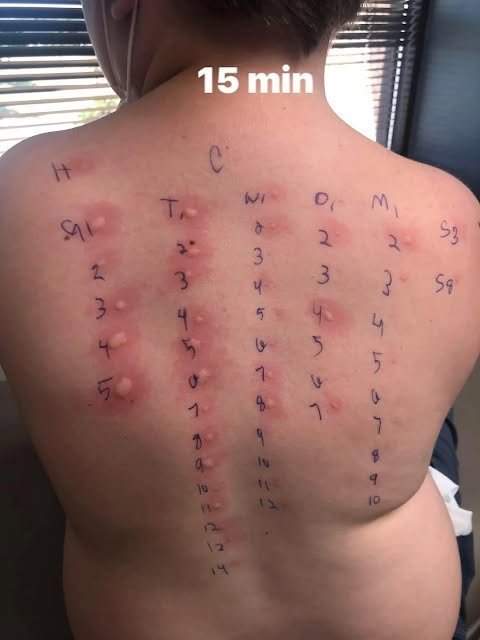
Digital media platforms frequently feature emotional personal photos showing children undergoing clinical medical procedures—such as a child’s back marked with localized skin reactions after 15 minutes of a skin prick test—paired with sensationalized or empathetic clickbait titles. These viral posts are deliberately posted to evoke parental sympathy, provoke worry regarding pediatric health, and drive rapid online comment sharing and engagement across social channels rather than providing accurate, clinical allergology guidance.
From a pediatric allergy and immunology perspective, the image depicts a standard, diagnostic skin prick test (SPT), which evaluates immediate Type I immunoglobulin E (IgE)-mediated hypersensitivity reactions. During an SPT, microscopic amounts of common environmental or food allergens (such as tree pollen, dust mites, pet dander, or mold) are applied to marked grid points on the skin, along with a positive control (histamine, marked as ‘H’) and a negative control (saline, marked as ‘C’). Within 15 minutes, mast cells in sensitized individuals release histamine, causing localized, transient cutaneous swelling (wheal) and redness (flare). While extensive skin reactivity can look dramatic or distressing, a positive skin test alone indicates sensitization and must be correlated with clinical symptoms by a medical professional. Content-farming networks systematically repurpose real clinical photos from personal social feeds into sensationalized health posts to exploit audience empathy and maximize ad revenue.
Managing pediatric allergies effectively involves structured diagnostic interpretation, identifying specific trigger exposures, maintaining appropriate symptom relief plans, and discussing long-term management or immunotherapy with healthcare providers. Medical diagnostic interpretation relies on comprehensive clinical evaluation rather than superficial social media reactions. If your child is undergoing allergy testing, experiencing recurrent allergic reactions, or requiring guidance on pediatric skin prick results, consulting a board-certified allergist, immunologist, or pediatrician provides safe, evidence-based care.
Leave a Reply