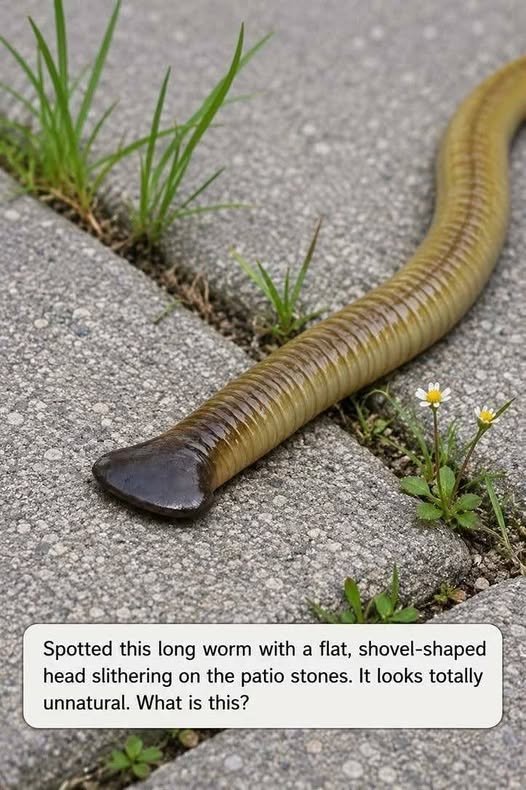
That bizarre creature crawling across the patio is probably a hammerhead flatworm, also called a land planarian or shovel-headed garden worm. Its most unmistakable feature is the strange, flattened head that resembles a tiny shovel, pickaxe, or hammerhead shark. Unlike ordinary earthworms, these animals have long, flat, unsegmented bodies and move by gliding across a thin layer of mucus. They are usually found in damp environments, particularly around mulch, leaf litter, rocks, logs, flowerpots, and other places where moisture remains.
Despite looking like something from a science-fiction movie, it isn’t a mysterious new creature. Hammerhead flatworms are predatory terrestrial flatworms that hunt other small animals, especially earthworms and, depending on the species, slugs and other soft-bodied prey. They capture prey using mucus and consume it with a mouth located on the underside of the body rather than at the head. Some species can grow surprisingly long—certain shovel-headed garden worms can reach around 12 inches (30 cm). Their unusual appearance and predatory behavior are why gardeners sometimes become concerned when they discover one.
If you find one, avoid handling it with bare hands. Extension specialists recommend using gloves because some hammerhead worms produce mucus containing tetrodotoxin, and contact with the eyes or mouth should be avoided. They are not considered a typical danger to people, but they can be ecologically significant because they prey on earthworms that contribute to healthy soil. Also, don’t deliberately cut one into pieces: some land planarians can regenerate after fragmentation, potentially producing additional individuals. If you want an exact species identification, a clear photograph showing the head shape, body stripes, size, and location is usually needed because several species look very similar. Disclaimer: This article provides general educational information and cannot confirm the identification of a particular specimen without seeing it. Hammerhead flatworms vary by species and region, so verify identification with a local extension service or qualified wildlife/entomology expert before taking action.
Leave a Reply