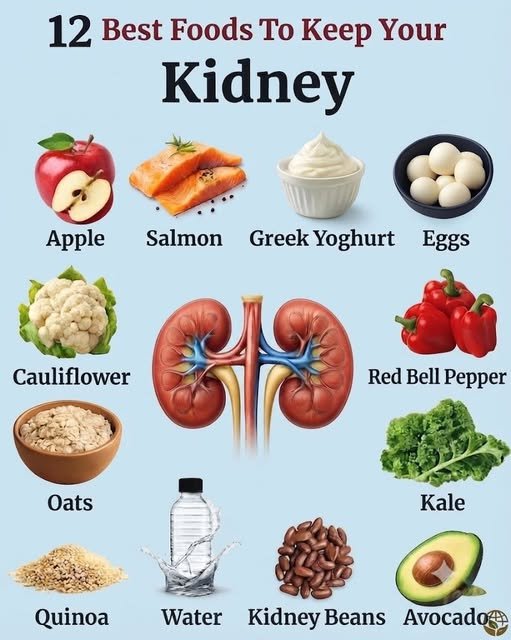
The graphic lists “12 Best Foods To Keep Your Kidney” healthy, featuring apples, salmon, Greek yogurt, eggs, cauliflower, red bell peppers, oats, kale, quinoa, water, kidney beans, and avocado.
While several of these items are excellent for general wellness or early-stage kidney health, some can actually be dangerous for individuals with Chronic Kidney Disease (CKD) or impaired kidney function. Renal nutrition is highly individualized and depends heavily on a person’s specific stage of kidney disease.
The Good, the Risky, and the Misleading
1. Truly Kidney-Friendly Choices (Low Potassium & Phosphorus)
- Cauliflower & Red Bell Peppers: Naturally low in potassium and rich in antioxidants, making them ideal staples for almost all stages of kidney health.
- Apples: Low in potassium, sodium, and phosphorus, offering safe dietary fiber and anti-inflammatory properties.
- Egg Whites: While whole eggs contain phosphorus in the yolk, egg whites provide high-quality protein with low phosphorus levels, which is often recommended for renal diets.
2. High-Risk Foods for Advanced CKD (Potassium & Phosphorus Warnings)
- Avocado & Kidney Beans: These are extremely high in potassium. When kidneys fail to filter excess potassium, it builds up in the blood (hyperkalemia), which can lead to life-threatening heart arrhythmias.
- Greek Yogurt & Salmon: High in phosphorus and protein. Impaired kidneys struggle to excrete phosphorus, leading to bone loss and cardiovascular calcification. Protein intake must also be carefully monitored in advanced non-dialysis CKD to avoid taxing the kidneys.
- Kale, Quinoa, & Oats: Containing moderate-to-high levels of potassium or phosphorus, these require careful portion management for those on restricted renal diets.
Deconstructing Health Infographic Clickbait
Simplified “top 10” or “12 best foods” health graphics are widely shared on social media, but they often present oversimplified or misleading information:
- One-Size-Fits-All Fallacy: They ignore clinical stages. A food that prevents kidney stones in a healthy adult (e.g., high-water or high-fiber foods) can be harmful to a late-stage CKD patient requiring fluid or potassium restrictions.
- Visual Wordplay (“Doctrine of Signatures”): Including kidney beans purely because they look like physical kidneys is a common visual gimmick, despite their high potassium content making them unsuitable for many kidney patients.
- Algorithmic Engagement: Generic health lists generate high save-and-share rates from well-meaning scrollers, boosting the page’s visibility while spreading potentially unsafe medical generalizations.
Leave a Reply