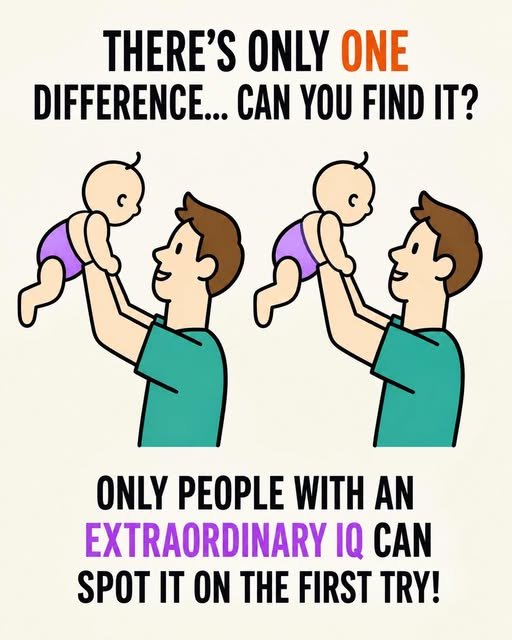
Social media feeds are frequently flooded with bright, simplified illustrations paired with bold, hyperbolic text such as “There’s only ONE difference… ONLY people with an EXTRAORDINARY IQ can spot it!” These graphics rely on artificial challenge, flattery, and psychological curiosity to trick users into spending time analyzing the image and interacting with the post.
Despite the dramatic claim on the image, a pixel-by-pixel examination reveals that the two side-by-side figures are completely identical. There is no missing line, altered color, shifted feature, or hidden element between the left illustration and the right illustration.
How Fake “IQ” Puzzles Drive Online Engagement
This tactic is a well-established psychological trick used across social platforms to manipulate user activity and algorithmic reach:
- Inflating Watch Time and Dwell Time: By claiming a single difference exists, the post forces users to stare at the image for an extended duration. Social media algorithms register this prolonged viewing time as high user interest, automatically boosting the post to a wider audience.
- Exploiting the Comment Section: Frustrated or confused users flood the comment section to state that the images are identical, argue with other users, or ask for the answer. Every comment signals activity to the platform’s distribution system.
- Flattery as Clickbait: Framing simple visual puzzles around “high intelligence” or “extraordinary IQ” appeals to cognitive vanity, encouraging people to share or comment to prove their observation skills.
Recognizing fake puzzles and engagement bait helps users avoid wasting time on artificial internet traps created solely to farm views, comments, and ad revenue.
Leave a Reply