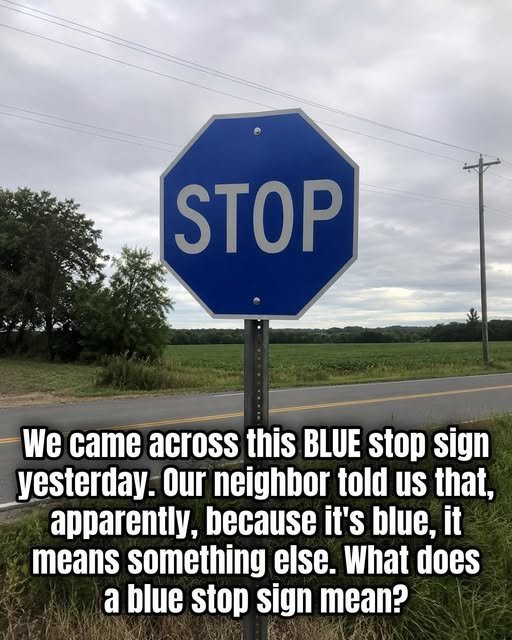
Social media images featuring unusual roadside signage paired with captions asking “What does a blue stop sign mean?” are classic examples of engagement farming. Content creators circulate these manipulated photos to spark debate, prompt hundreds of speculation-filled comments, and drive users to click external links hosted in the comment sections.
JPG+ 1
Under official transportation standards, such as the Manual on Uniform Traffic Control Devices (MUTCD), a blue stop sign holds no legal standing on public roads. Standard regulatory stop signs are strictly mandated to be red octagons with white lettering to ensure immediate global recognition and safety compliance. Blue traffic signs are universally reserved for informational and motorist services, such as indicating nearby lodging, food, hospital access, or gas stations.
When blue stop signs do appear in the real world, they are almost exclusively non-standard additions installed on private property—such as commercial parking lots, gated communities, or private driveways—where property owners attempt to match custom neighborhood color themes. In many cases online, the sign’s color is simply altered using photo editing software to create a fake viral curiosity. Regardless of a non-standard color, drivers on private property should still yield or stop for safety, but the image itself primarily serves as clickbait.
JPG+ 1
Leave a Reply