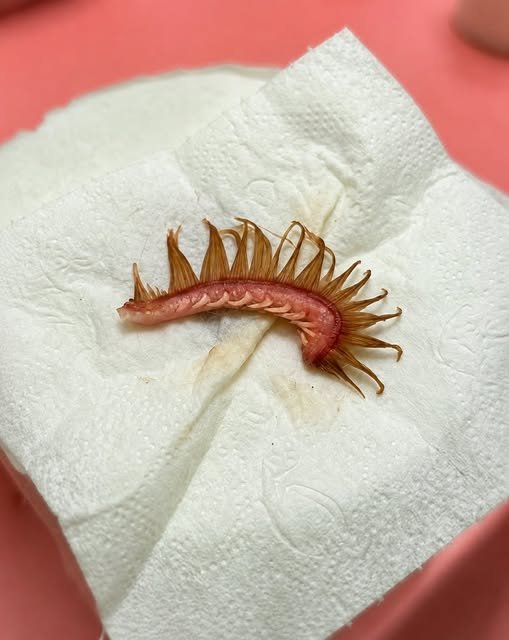
The bizarre, creature-like object shown resting on a paper towel is the severed oral disc and tentacles—commonly referred to as the crown—of a sea anemone (order Actiniaria).
Biological Origin and Mechanics
- Anatomy: The central pinkish ring with uniform internal ridges represents the mouth/pharynx area, while the radiating brownish strands are the tentacles used by anemones to catch prey.
- Detachment: Sea anemones are marine invertebrates related to jellyfish and corals. When a washed-up anemone dies or is scavenged by birds or marine life along a shoreline, the delicate tissue of the outer tentacle crown easily detaches from the main muscular foot or body column.
- Coastal Scavenging: If a dog is walking along a beach or coastal area, it can easily brush against or step on exposed marine debris, allowing the sticky or fibrous tissue of the detached crown to cling to its fur.
Social Media Context and Engagement Farming
Viral posts featuring unusual marine fragments paired with anxious, domestic stories—such as “My girlfriend came home after a walk with the dog… Attached to the dog’s fur…”—are textbook examples of social media engagement farming.
Content creators frame alien-looking biological specimens within familiar domestic scenarios to manipulate audience behavior:
- Evoke Shock and Curiosity: The organism’s strange, centipede-like appearance triggers a visceral reaction, compelling users to stop scrolling, zoom in, and inspect the photo.
- Drive High Comment Activity: Posing open-ended identification questions generates thousands of comments ranging from humorous guesses about alien life to genuine scientific corrections, which signals social algorithms to amplify the post’s reach.
- Monetization Traffic: Captions often point toward comment section links leading to external clickbait articles, ad-supported blogs, or viral content storefronts.
While the detached crown looks like a mysterious terrestrial pest or parasite, it is simply harmless, washed-up ocean fauna.
Leave a Reply