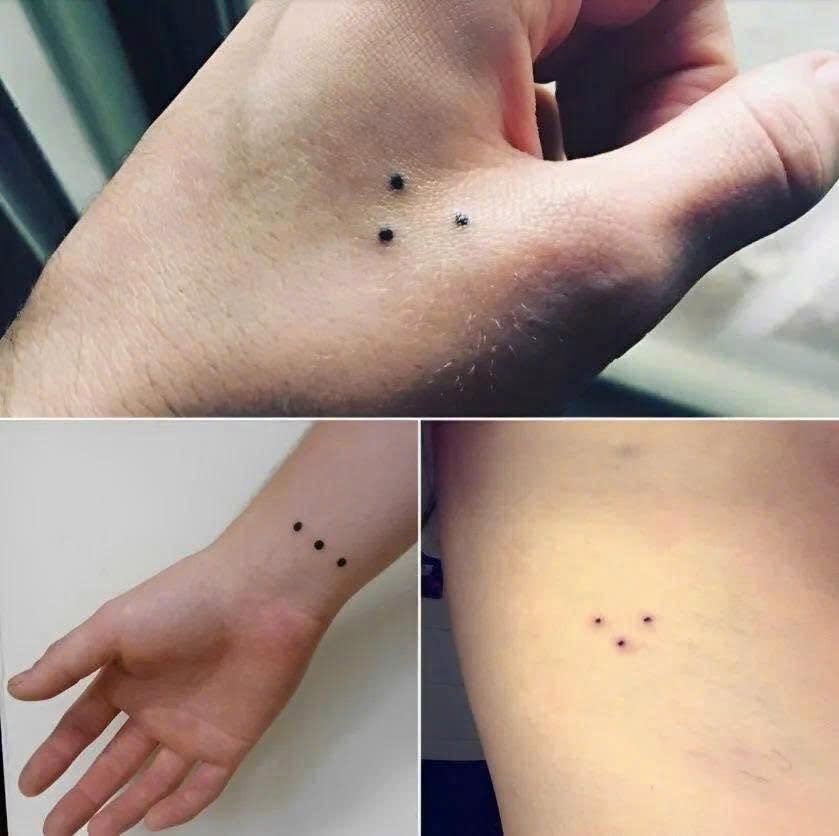
Digital media platforms frequently feature close-up photographs of simple hand or wrist tattoos consisting of three small dots, accompanied by dramatic warnings urging people to flee if they encounter someone with these markings. These viral posts rely on threat sensationalism, fear framing, and extreme safety claims to provoke alarm, encourage shares, and maximize social media engagement metrics rather than providing nuanced, accurate sociological or criminological context.
From a criminological and subcultural perspective, the “three dots” tattoo (often placed on the web of the hand, wrist, or near the eye) historically carries the symbolic meaning of “mi vida loca” (“my crazy life”) or represents religious concepts such as the Holy Trinity in various regional communities. While historically associated with generic prison culture, criminal subcultures, or localized gang affiliations, the three-dot design is also widely adopted as a minimalist geometric tattoo, a symbol of personal resilience, or a stick-and-poke aesthetic trend among individuals with no criminal connections whatsoever. Claiming that encountering a person with a minimalist three-dot marking poses an immediate physical danger or requires instant evasion is a gross distortion of subcultural symbolism. Content-farming networks systematically oversimplify complex social motifs into extreme survival warnings to maximize digital click-through rates and advertising revenue.
Navigating body art symbolism requires distinguishing between historical subcultural motifs, modern aesthetic fashion, and actual behavioral risk. The presence of a simple geometric tattoo provides no definitive proof of an individual’s background, intent, or personal character. Objective risk assessment relies on actual human behavior, environmental context, and situational awareness rather than sensationalized online warnings about basic skin art. If you are interested in subcultural history, criminal iconography, or tattoo anthropology, consulting academic criminological literature, sociological studies, or professional body art historians provides accurate and objective insight.
Leave a Reply