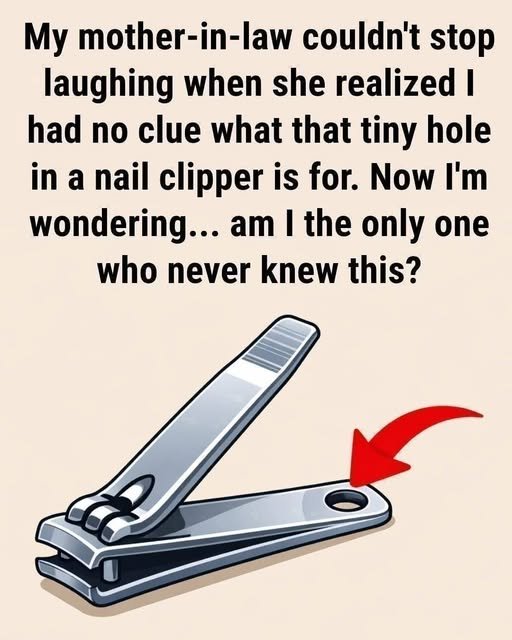
The graphic features a simple illustration of a standard nail clipper with a bright red arrow pointing to the circular hole at the back base, paired with a classic social media narrative: “My mother-in-law couldn’t stop laughing when she realized I had no clue what that tiny hole in a nail clipper is for…”
While viral articles and clickbait headlines attempt to frame this feature as a “hidden life hack” or secret multi-tool function, the primary reason for that small hole is entirely functional manufacturing, assembly, and attachment design.
What the Hole is Actually For
- Keychain & Lanyard Attachment Point:
- The most practical everyday use is to pass a small key ring, bead chain, or string through the hole so the clippers can be attached to a keychain, toiletry bag, or travel kit to prevent loss.
- Manufacturing & Assembly (Riveting / Stamping):
- During industrial production, metal stamping machines punch out the clipper handles. Holes serve as alignment pin guides on factory conveyor lines so automated machinery can hold, position, and assemble the levers accurately.
- On models with swinging fold-out nail files or debris catchers, the hole serves as the pivot or anchor point for a small pin or rivet holding those accessories attached to the base.
- Grip and Material Reduction:
- Punching out a small circle reduces raw material weight across millions of manufactured units without sacrificing the structural integrity of the steel base.
Debunking Common Viral “Life Hack” Myths
Content-farm videos often invent bizarre “hidden uses” for this hole to farm engagement. Common false claims include:
- “It’s a wire stripper” (Using the hole to strip electrical wire is inefficient, damages the metal, and poses a safety risk).
- “It’s a thread cutter / needle threader” (While you can loop string through it, it is not engineered as a cutting die).
- “It’s designed to bend paperclips or hooks” (Any hole in metal can bend wire, but that is not its intended design).
Deconstructing Everyday Object Clickbait
This post uses a classic content-farm strategy to drive social media reach:
- Fabricated Social Shame / Relatability: Adding a fake personal story (“My mother-in-law couldn’t stop laughing…”) makes the reader feel out of the loop or curious about what they might be missing.
- Visual Focal Point (The Red Arrow): Drawing an oversized red arrow pointing to a mundane object feature creates an instant visual hook, causing scrollers to pause mid-feed.
- Comment Inflation: Asking a direct question (“am I the only one who never knew this?”) guarantees that hundreds of users will jump into the comments to post simple answers, debate hacks, or share personal stories. This comment activity signals high interaction to social media algorithms, pushing the graphic to a wider audience.
Leave a Reply