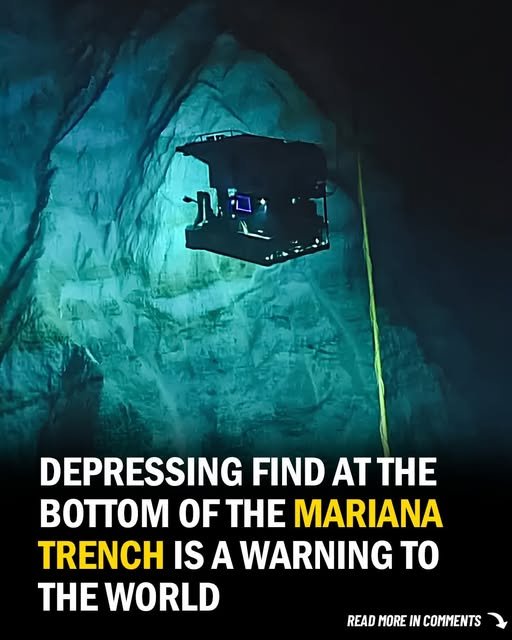
The graphic displays a deep-sea submersible illuminated against an underwater wall, accompanied by a sensational headline: “DEPRESSING FIND AT THE BOTTOM OF THE MARIANA TRENCH IS A WARNING TO THE WORLD” paired with your prompt “It was spotted 35,000ft deep in the Mariana Trench”.
While the clickbait formatting implies the discovery of an apocalyptic anomaly or hidden sea monster, the actual headline references real scientific expeditions that discovered human pollution—specifically plastic waste and trash—at the deepest point on Earth.
What Explorers Actually Discovered
- Plastic Bag at 35,849 Feet (10,928 Meters):
- During Victor Vescovo’s historic record-breaking dive to the Challenger Deep in May 2019 aboard the Limiting Factor submersible, researchers documented human debris, including a plastic bag and candy wrappers, lying on the trench floor.
- A separate earlier study examining the Deep-Sea Debris Database maintained by JAMSTEC (Japan Agency for Marine-Earth Science and Technology) also confirmed a single-use plastic bag recorded at 35,754 feet (10,898 meters).
- Microplastics and Chemical Contaminants:
- Marine biologists studying amphipods (small crustaceans) collected from the Mariana Trench found microplastics inside the guts of over 80% of the creatures tested.
- Research has also revealed high concentrations of banned persistent organic pollutants (like PCBs) in deep-sea organisms, carried down as organic debris sinks to the ocean floor.
Deconstructing the Deep-Sea Clickbait Template
This post leverages classic social media engagement-farming tactics:
- Vague Alarmism (“Warning to the World”): Avoiding specific mention of “plastic pollution” creates a dramatic mystery, tricking scrollers into assuming scientists found something biological, supernatural, or catastrophic.
- The “Read More in Comments” Funnel: Directing users to the comment section (“READ MORE IN COMMENTS ⤵”) inflates post engagement metrics, triggering platform algorithms to push the post to thousands of additional feeds.
- Dramatic Underwater Visuals: Using high-contrast imagery of an illuminated submersible at extreme depths exploits fear of the unknown (thalassophobia) to guarantee a scroll-stop.
Leave a Reply