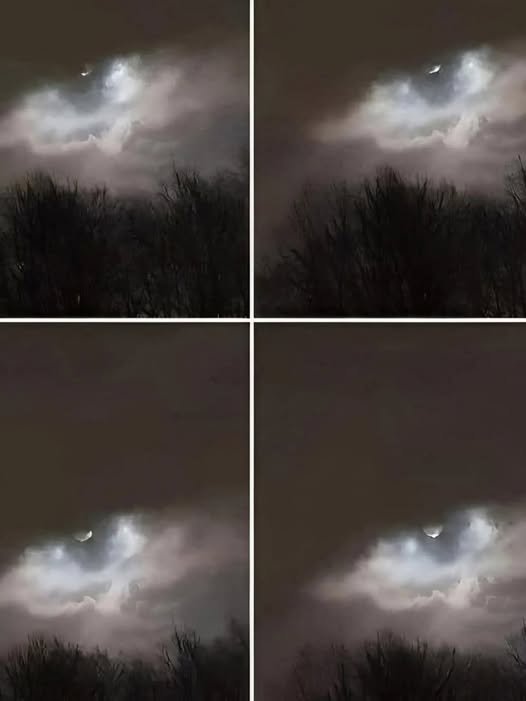
The image displays a grid of four photo panels showing backlit night clouds parted around the moon above a treeline, paired with a classic mystery caption (“My brother took this photo only 21 km from our house… no one noticed the most important detail!”). This graphic represents a pareidolia-driven engagement template engineered to trigger optical curiosity and artificial debate.
Anatomy of the Illusion & Clickbait Strategy
- The Optical Illusion (Pareidolia): When viewed as a whole, the cloud formation lit by the moon naturally resembles a giant, glowing human eye staring out of the dark sky. The crescent moon forms the glint or pupil, while the surrounding breaks in the dark cloud cover form the sclera and eyelids. This psychological phenomenon—where the human brain perceives familiar shapes (like faces or eyes) in random patterns—is known as pareidolia.
- The “Hidden Detail” Lie: Claiming that “no one noticed the most important detail” is a deliberate mind game. There is no secret anomaly, hidden craft, or secondary detail in the image. The entire focus is simply the eye-like optical illusion created by normal cloud geometry.
- Grammatical Inconsistency as Bait: Notice the subtle contradiction in the caption (“My brother took this photo… She shared it on her page”). Content farms frequently use automated or translated text templates with pronoun errors, which double as accidental comment-bait when users enter the reply section to point out the typo.
- Algorithmic Monetization: Prompts claiming a “hidden detail” force viewers to stare at the image longer (increasing dwell time) and zoom in. When users jump into the comments to ask what the detail is or state that they see an eye, the platform algorithm registers massive engagement, boosting the post’s reach to monetize ad impressions.
Leave a Reply