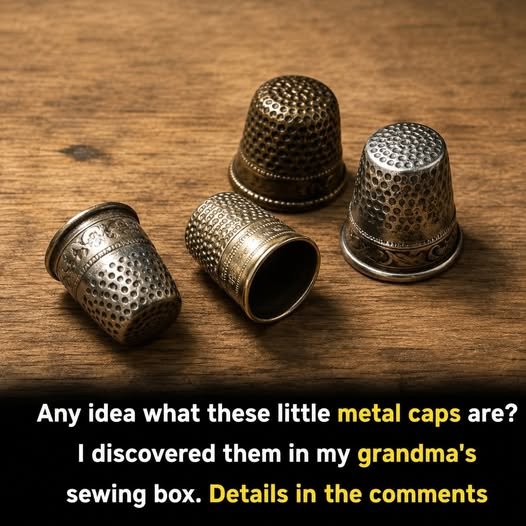
The image displays four antique metal sewing thimbles sitting on a wooden surface, accompanied by text asking, “Any idea what these little metal caps are? I discovered them in my grandma’s sewing box.” This graphic represents a classic synthetic query clickbait template designed to exploit obvious household items to drive digital interaction and platform reach.
Anatomy of the Object & Strategy
- Identification: The items shown are ordinary metal thimbles, an ancient and universally known tailoring tool designed to fit over a fingertip. Their pitted surface (dimples) prevents needle eyes from slipping when pushing thick thread through tough fabrics.
- The Contradictory Prompt Trap: Notice the disparity between the user’s prompt (“found in my grandmother’s crockery cupboard”) and the text embedded in the image itself (“discovered them in my grandma’s sewing box”). This mismatch highlights how content networks recycle generic stock images of common objects while appending varied, fake origin stories.
- The False Ignorance Mechanism: Pretending not to know the identity of an ubiquitous tool—especially when the image text explicitly mentions a “sewing box”—is a calculated tactic. It triggers the viewer’s impulse to correct the poster, leading hundreds of users to type “It’s a thimble!” into the comments.
- Monetization Drive: High comment volume and rapid user engagement signal to social media algorithms that the post is generating high interest. This artificially inflates the post’s visibility, enabling page administrators to farm followers, monetize ad impressions, and direct traffic to monetized landing pages.
Leave a Reply