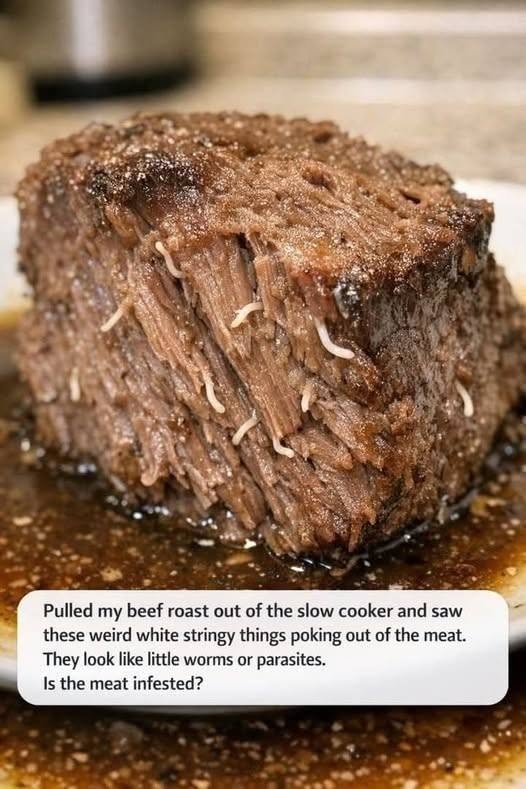
The white, stringy structures visible in the beef roast are completely harmless anatomical features rather than parasitic worms or maggots. While their appearance can cause concern, these strands are small blood vessels, nerve sheaths, or connective tissue channels naturally embedded within muscle tissue. When beef is cooked low and slow, muscle fibers contract and tighten around these hollow, elastic structures, forcing them outward between the meat’s grain.
Anatomical Characteristics vs. Parasites
- Structure and Texture: Blood vessels are hollow, firm, and elastic, holding their tubular shape when pulled. Parasites or larvae are soft, segmented, and disintegrate rapidly when exposed to prolonged heat.
- Location and Pattern: These vessels run parallel along the muscle fiber bundles, emerging uniformly from the cut edges of the meat.
- Color: After extensive cooking, vascular collagen and elastine lose their red coloration and turn a pale white or translucent tan.
Food Safety and Preparation
- Safe Internal Temperature: Cooking beef in a slow cooker to an internal temperature above 63°C (145°F) for whole cuts neutralizes standard foodborne pathogens and parasites.
- Removal: If the texture or appearance is unappealing, simply pick the strands out with tongs or trim them away before serving. The surrounding meat remains entirely safe to consume.
Leave a Reply