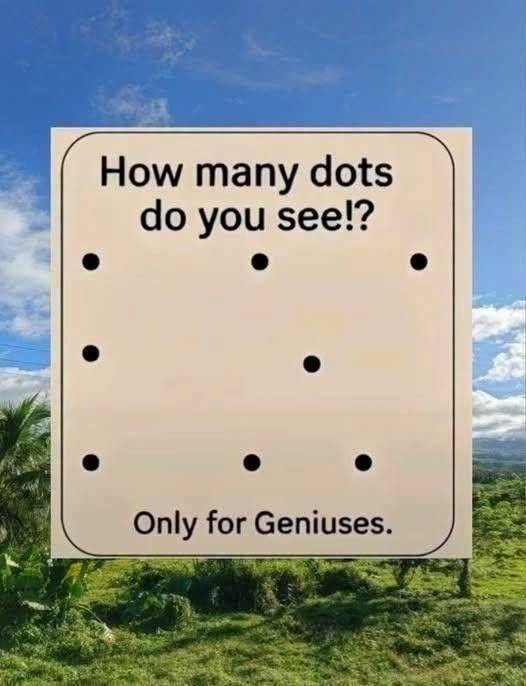
Digital media platforms frequently feature visual puzzles paired with exclusive or challenging headlines—such as claiming that counting dots on a grid is an optical illusion meant “only for geniuses.” These viral posts are specifically engineered to provoke curiosity, challenge user intellect, and drive rapid online comment sharing and engagement.
From a cognitive psychology and visual perception perspective, this specific image is a famous extinction illusion (often related to Hermann grid or Ninio’s extinction illusion variants). The grid is designed with subtle intersecting white lines and gray pathways that manipulate peripheral vision. When you look directly at any single dot, you can see it clearly; however, due to the way human retinal ganglion cells process high-contrast intersection points in the peripheral field, other black dots seem to mysteriously vanish and reappear when your gaze shifts. Sensationalized online content routinely frames simple neuroscientific visual phenomena as intelligence tests to maximize digital interaction and comments.
Enjoying visual puzzles and cognitive tests involves understanding how human visual processing, attention, and peripheral perception work rather than buying into exaggerated clickbait claims about innate genius. Evaluating visual stimuli is most reliable when grounded in psychological science and perceptual mechanics. If you are interested in exploring how the human brain processes visual information, consulting resources on cognitive psychology and visual neuroscience offers fascinating, evidence-based insights.
Leave a Reply